Felix Szczesny
Game Designer
GET THE POWER TO THE TOWER
Electropolis is a single-player puzzle game with building block elements. Players build giant mechanical, controllable arms on top of a colossal city in order to transport an orb that has to illuminate all the buildings.
ELECTROPOLIS
 |
|---|
 |
 |
 |
 |
 |
 |
 |
 |
 |
 |
 |
DATE : 3rd semester (2019-2020)
DURATION : 4 months
TEAM : Hagen Frick, Delia Rekowski, Christoph Weinreich, Felix Szczesny
COACHES : Prof. Susanne Brandhorst and Prof. Thomas Bremer
TECHNOLOGY : Unity 3D
CONSTRAINS : Create a 3D game with maximum 12 objects.
MY PARTS :
-
System design and concept development
-
Gameplay programming
-
Level Design
-
Organisational and management work
PROJECT INFORMATION
BE THE ENGINEER ABOVE THE CLOUDS
Electropolis is a calm game mixing creative building and the fantasy of steering huge constructions while taking players to a completely different place.
It is a game that offers players a lot of freedom in finding solutions for the levels.
WORKFLOW EXAMPLES
Analog prototyping and inspirations
I proposed to approach the development very visually. Trying to find inspiration for mechanics and systems by searching for interesting images on Pinterest. The final game evolved a lot since this early prototyping.


Getting the right feel
I did most of the programming of the final game and an important part was the steering of the mechanical arms.
.png)
Blockout
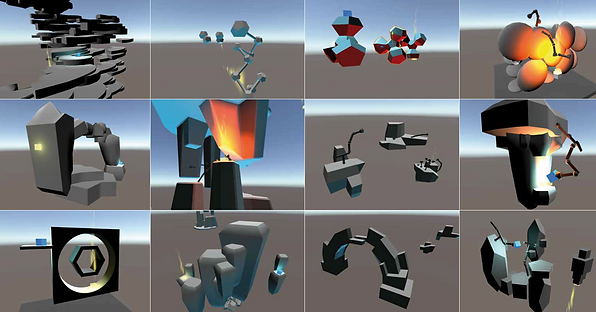
I made many blockouts to test our mechanics and find interesting situations for our levels.
We iterated them over, considering general architectual appeal, playfulness and specific things we wanted to teach.

Channel play
We first wanted to make smaller and separated levels. But it was a good thing to make longer ones composed of different small challenges.
-
We could theme a level and focus on one mechanic in different situations.
-
Providing challenges in chunks focuses the player's attention on the current challenge, and doesn't make them feel overwehlmed. They get eager to discover what's next as the buildings only rise out of the clouds when they finished a challenge. These also turned out to be powerful rewards.
.png)
Shaping a level
We also testet the feeling of different Level shapes. It was quickly clear that placing on round shapes didn't felt good at all. And players where more excited to play in an environment that felt like an actual place rather than something too abstract.
Playtesting
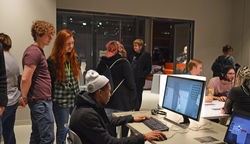
As always playtesting helped us to make decisions and showed us which parts of our game were interesting and should be focused in the next iteration.


Regular meetings
Meetings were held in short intervals during the ideation process and then once or twice a week for prototyping and development. I wrote protocols for some of our meetings. I learned that it is in most cases more productive to keep them short and focused. I still tend to make long meetings but I try to become more efficient.

17.png)
Documentation
We used a digital pinboard to write down what we created, to organise our ideas and keep track of decisions. It helped us to clarify our vision of the game as a team, and to have documents to refer to during development.
MY EXPERIENCE & LEARNINGS
The positives
Many people enjoyed playing the game and invested a lot of time into trying out different constructions. I am very happy with the game flow we managed to create. The game has a good balance between communicating clear goals, challenge and reward.
Even thought the development process had its difficulties, the teamwork worked very well because we communicated a lot.
The negatives
Unfortunately we made some basic designer mistakes: not taking enough decisions and not getting happy with the project. I thought I was already aware of these things but I think, I had to experience them once to handle them better.
In the same way we also made way to many digital prototypes. I've learned from this that it is good to come up with a variety of propositions, but that it is more important to know what you want to design and why.
The future of Electropolis
Electropolis is a nice portfolio piece for me and taught me a lot, but I won't develop it any further.
There are still some aspects I will reuse, like for example the way we provided bit by bit challenges for the players, or how huge rewards benefited the experience.
As we developed many prototypes, I also consider having created a lot of interesting mechanics and ideas that I could reuse in future games.
Other projects


